Cesare_Zavattini
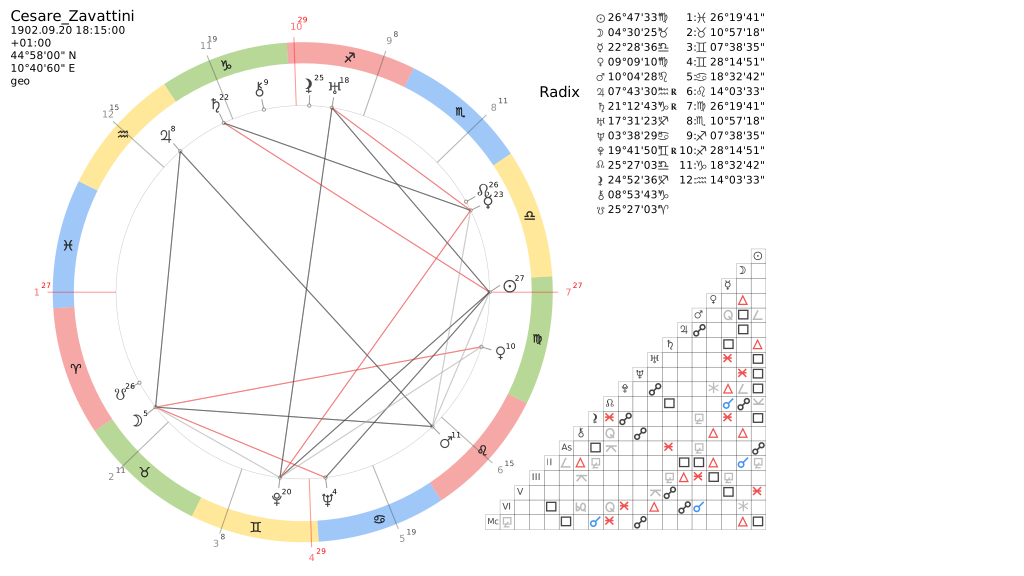
Cesare Zavattini (20 September 1902 – 13 October 1989) was an Italian screenwriter and one of the first theorists and proponents of the Neorealist movement in Italian cinema.
Cesare Zavattini (20 September 1902 – 13 October 1989) was an Italian screenwriter and one of the first theorists and proponents of the Neorealist movement in Italian cinema.
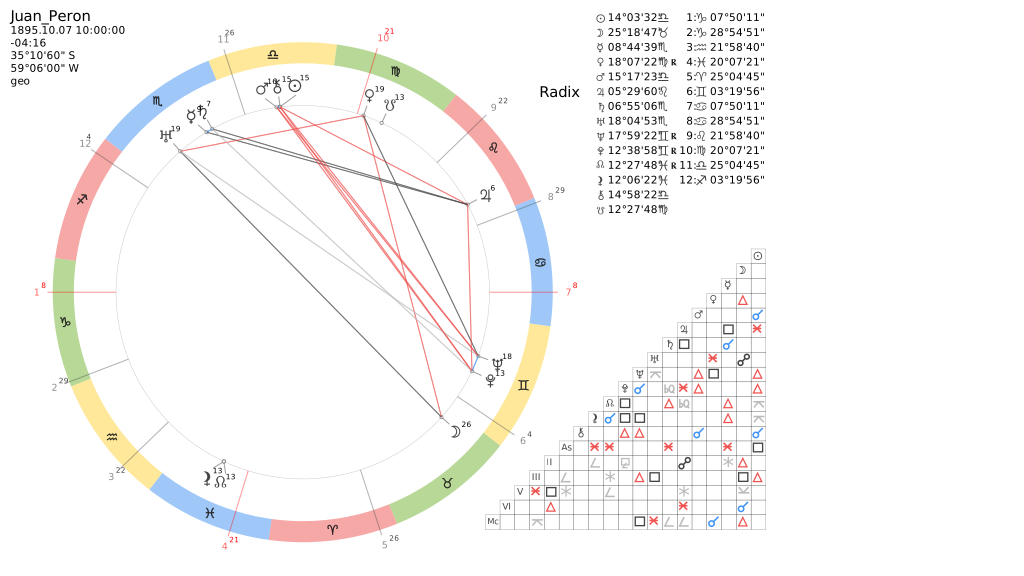
Juan Domingo Perón (UK: , US: , Spanish: [ˈxwan doˈmiŋɡo peˈɾon] ; 8 October 1895 – 1 July 1974) was an Argentine Army lieutenant general and politician who served as the 35th President of Argentina from 1946 to his overthrow in 1955, and again as the 45th President from October 1973 to his death in July 1974. He had previously served in several government positions, including Minister of Labour and Vice President under presidents Pedro Pablo Ramírez and Edelmiro Farrell.
During his first presidential term (1946–1952), Perón was supported by his second wife, Eva Duarte ("Evita"); they were immensely popular among the Argentine working class. Perón's government invested heavily in public works, expanded social welfare, and forced employers to improve working conditions. Trade unions grew rapidly with his support and women's suffrage was granted with Eva's influence. His government was also known to employ dictatorial tactics; several dissidents were fired, exiled, or arrested, and much of the press was closely controlled. Several high-profile fascist war criminals, such as Josef Mengele, Adolf Eichmann, and Ante Pavelić, were given refuge in Argentina during this time.
Perón was re-elected by a fairly wide margin, though his second term (1952–1955) was far more troubled. Eva, a major source of support, died a month after his inauguration in 1952. An economic crisis was ongoing, Perón was accused of having a relationship with a teenage girl, Nelly Rivas, and his plans to legalise divorce and prostitution damaged his standing with the Catholic Church. After he deported two Catholic priests and was mistakenly thought to be excommunicated, pro-Church elements of the Argentine Navy and Air Force bombed Plaza de Mayo in Buenos Aires, where supporters of Perón had gathered, in June 1955. More than 300 civilians were killed in this coup attempt, which in turn prompted violent reprisals against many churches by Perón's supporters. Within months, a successful coup deposed him.
During the following period of two military dictatorships, interrupted by two civilian governments, the Peronist party was outlawed and Perón was exiled. Over the years he lived in Paraguay, Venezuela, Panama, and Spain. When the Peronist Héctor José Cámpora was elected President in 1973, Perón returned to Argentina amidst the Ezeiza massacre and was soon after elected President for a third time (12 October 1973 – 1 July 1974). During this term, left- and right-wing Peronists were permanently divided and violence between them erupted, with Perón increasingly siding with the right. His minister José López Rega formed the Argentine Anticommunist Alliance, believed to have committed at least hundreds of extrajudicial killings and kidnappings. Perón's third wife, María Estela Martínez, known as Isabel Perón, was elected as Vice President on his ticket and succeeded him as President upon his death in 1974. Political violence only intensified, and she was ousted in 1976, followed by a period of even deadlier repression under the junta of Jorge Rafael Videla.
Although they are still controversial figures, Juan and Eva Perón are nonetheless considered icons by the Peronists. The Peróns' followers praised their efforts to eliminate poverty and to dignify labour, while their detractors considered them demagogues and dictators. The Peróns gave their name to the political movement known as Peronism, which in present-day Argentina is represented mainly by the Justicialist Party.
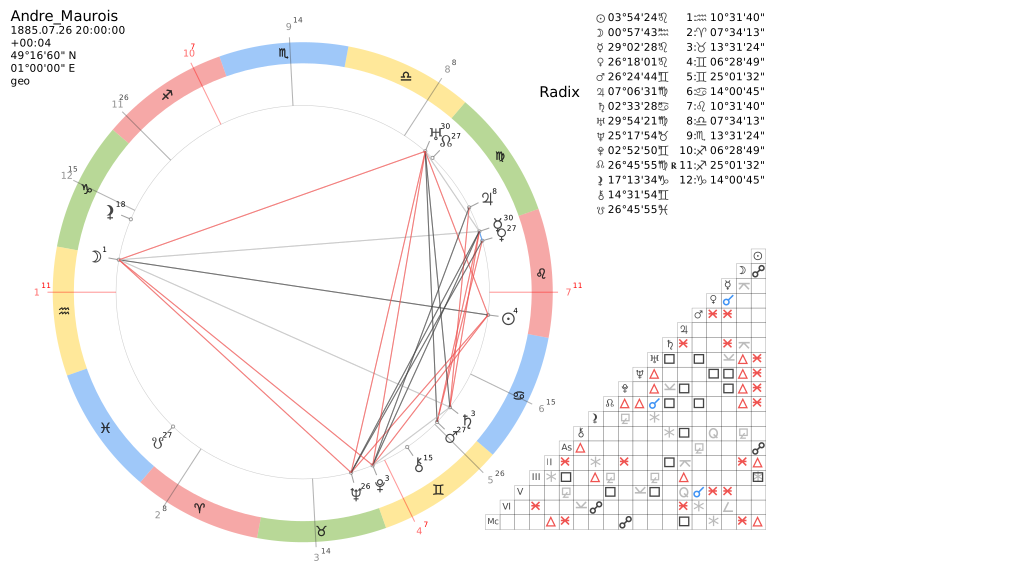
André Maurois (French: [mɔʁwa]; born Émile Salomon Wilhelm Herzog; 26 July 1885 – 9 October 1967) was a French author.
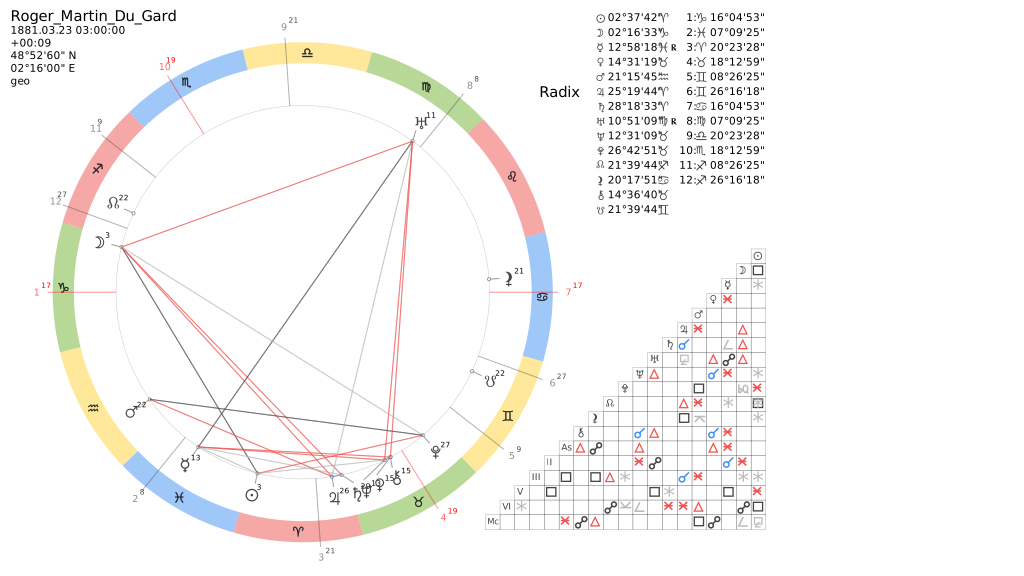
Roger Martin du Gard (French: [dy gaʁ]; 23 March 1881 – 22 August 1958) was a French novelist, winner of the 1937 Nobel Prize in Literature.
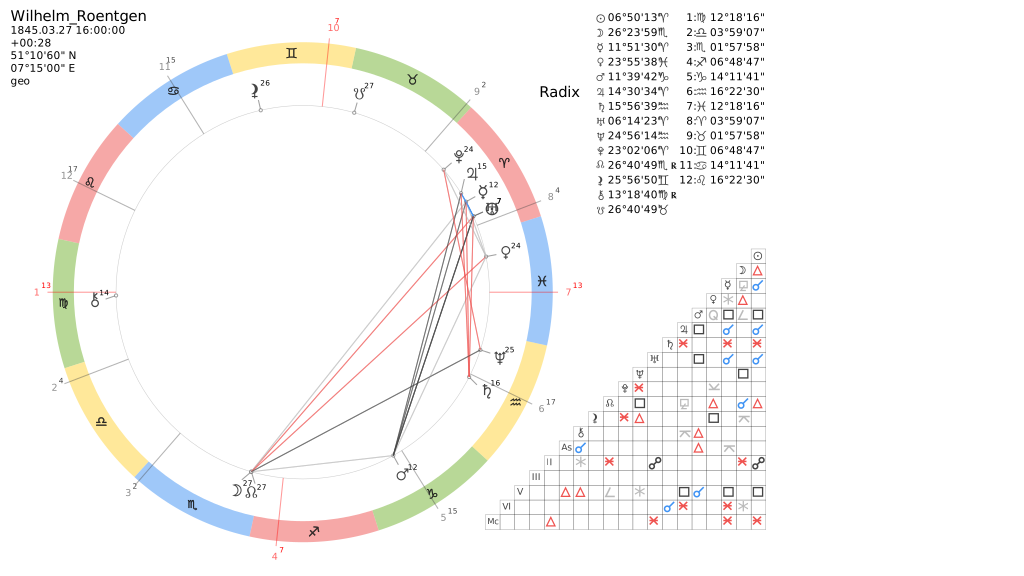
Wilhelm Conrad Röntgen (; German pronunciation: [ˈvɪlhɛlm ˈʁœntɡən] ; 27 March 1845 – 10 February 1923) was a German mechanical engineer and physicist, who, on 8 November 1895, produced and detected electromagnetic radiation in a wavelength range known as X-rays or Röntgen rays, an achievement that earned him the inaugural Nobel Prize in Physics in 1901. In honour of Röntgen's accomplishments, in 2004 the International Union of Pure and Applied Chemistry (IUPAC) named element 111, roentgenium, a radioactive element with multiple unstable isotopes, after him. The unit of measurement roentgen was also named after him.
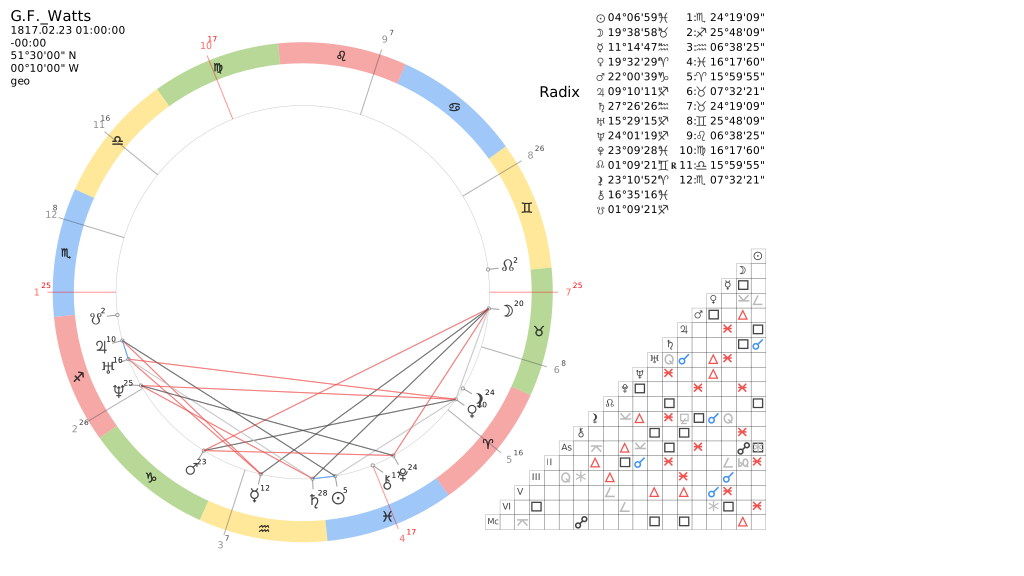
George Frederic Watts (23 February 1817 – 1 July 1904) was a British painter and sculptor associated with the Symbolist movement. He said "I paint ideas, not things." Watts became famous in his lifetime for his allegorical works, such as Hope and Love and Life. These paintings were intended to form part of an epic symbolic cycle called the "House of Life", in which the emotions and aspirations of life would all be represented in a universal symbolic language.
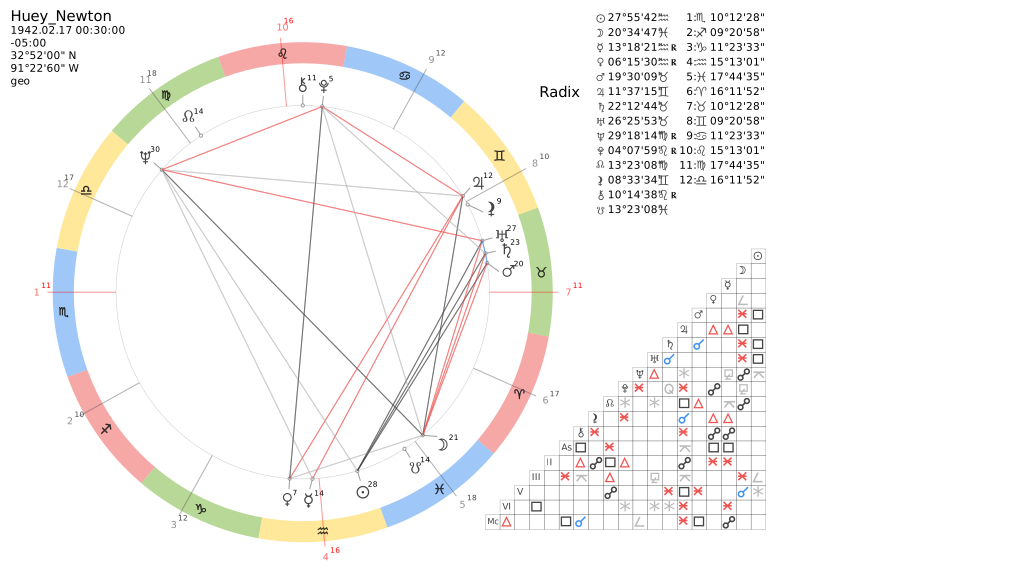
Huey Percy Newton (February 17, 1942 – August 22, 1989) was an African American revolutionary and political activist who founded the Black Panther Party. He ran the party as its first leader and crafted its ten-point manifesto with Bobby Seale in 1966.
Under Newton's leadership, the Black Panther Party founded over 60 community support programs (renamed survival programs in 1971) including food banks, medical clinics, sickle cell anemia tests, prison busing for families of inmates, legal advice seminars, clothing banks, housing cooperatives, and their own ambulance service. The most famous of these programs was the Free Breakfast for Children program which fed thousands of impoverished children daily during the early 1970s. Newton also co-founded the Black Panther newspaper service, which became one of America's most widely distributed African-American newspapers.
In 1967, he was involved in a shootout which led to the death of police officer John Frey and injuries to himself and another police officer. In 1968, he was convicted of voluntary manslaughter for Frey's death and sentenced to 2 to 15 years in prison. In May 1970, the conviction was reversed and after two subsequent trials ended in hung juries, the charges were dropped. Later in life, he was also accused of murdering Kathleen Smith and Betty Van Patter, although he was never convicted for either death.
Newton learned to read using Plato's Republic, which influenced his philosophy of activism. He went on to earn a PhD in social philosophy from the University of California at Santa Cruz's History of Consciousness program in 1980. In 1989, he was murdered in Oakland, California by Tyrone Robinson, a member of the Black Guerrilla Family.
Newton was known for being an advocate of self-defense and used his position as a leader within the Black Panther Party to welcome women as well.
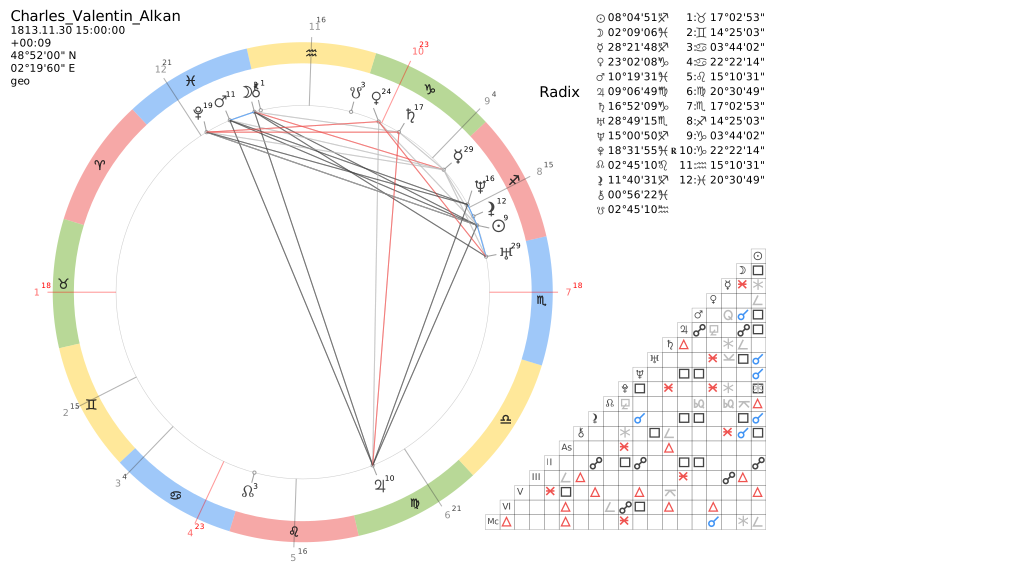
Charles-Valentin Alkan (French: [ʃaʁl valɑ̃tɛ̃ alkɑ̃]; 30 November 1813 – 29 March 1888) was a French composer and virtuoso pianist. At the height of his fame in the 1830s and 1840s he was, alongside his friends and colleagues Frédéric Chopin and Franz Liszt, among the leading pianists in Paris, a city in which he spent virtually his entire life.
Alkan earned many awards at the Conservatoire de Paris, which he entered before he was six. His career in the salons and concert halls of Paris was marked by his occasional long withdrawals from public performance, for personal reasons. Although he had a wide circle of friends and acquaintances in the Parisian artistic world, including Eugène Delacroix and George Sand, from 1848 he began to adopt a reclusive life style, while continuing with his compositions – virtually all of which are for the keyboard. During this period he published, among other works, his collections of large-scale studies in all the major keys (Op. 35) and all the minor keys (Op. 39). The latter includes his Symphony for Solo Piano (Op. 39, nos. 4–7) and Concerto for Solo Piano (Op. 39, nos. 8–10), which are often considered among his masterpieces and are of great musical and technical complexity. Alkan emerged from self-imposed retirement in the 1870s to give a series of recitals that were attended by a new generation of French musicians.
Alkan's attachment to his Jewish origins is displayed both in his life and his work. He was the first composer to incorporate Jewish melodies in art music. Fluent in Hebrew and Greek, he devoted much time to a complete new translation of the Bible into French. This work, like many of his musical compositions, is now lost. Alkan never married, but his presumed son Élie-Miriam Delaborde was, like Alkan, a virtuoso performer on both the piano and the pedal piano, and edited a number of the elder composer's works.
Following his death (which according to persistent but unfounded legend was caused by a falling bookcase), Alkan's music became neglected, supported by only a few musicians including Ferruccio Busoni, Egon Petri and Kaikhosru Sorabji. From the late 1960s onwards, led by Raymond Lewenthal and Ronald Smith, many pianists have recorded his music and brought it back into the repertoire.
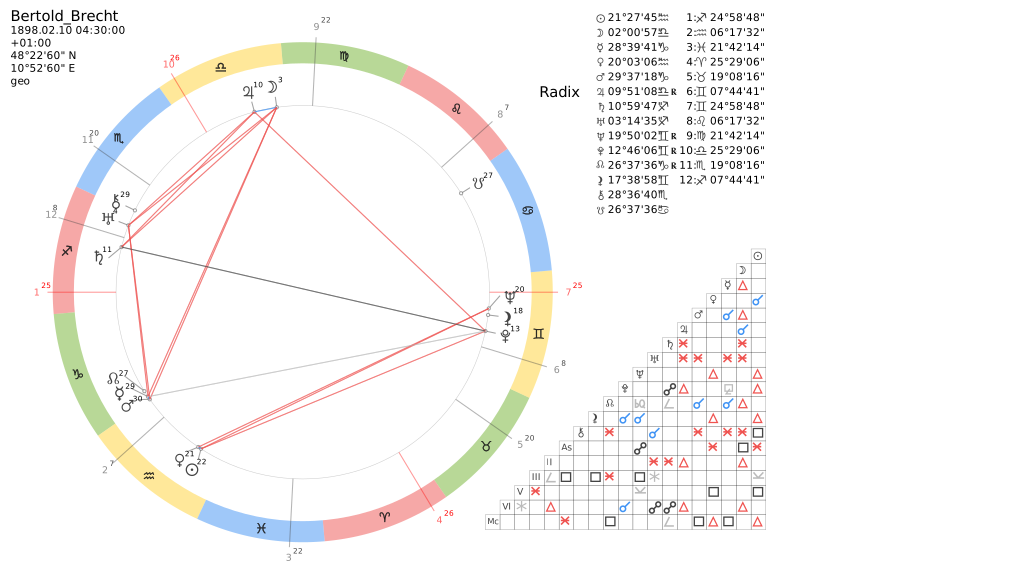
Eugen Berthold Friedrich Brecht (10 February 1898 – 14 August 1956), known professionally as Bertolt Brecht, was a German theatre practitioner, playwright, and poet. Coming of age during the Weimar Republic, he had his first successes as a playwright in Munich and moved to Berlin in 1924, where he wrote The Threepenny Opera with Kurt Weill and began a life-long collaboration with the composer Hanns Eisler. Immersed in Marxist thought during this period, he wrote didactic Lehrstücke and became a leading theoretician of epic theatre (which he later preferred to call "dialectical theatre") and the Verfremdungseffekt.
During the Nazi Germany period, Brecht fled his home country, first to Scandinavia, and during World War II to the United States, where he was surveilled by the FBI. After the war he was subpoenaed by the House Un-American Activities Committee. Returning to East Berlin after the war, he established the theatre company Berliner Ensemble with his wife and long-time collaborator, actress Helene Weigel.
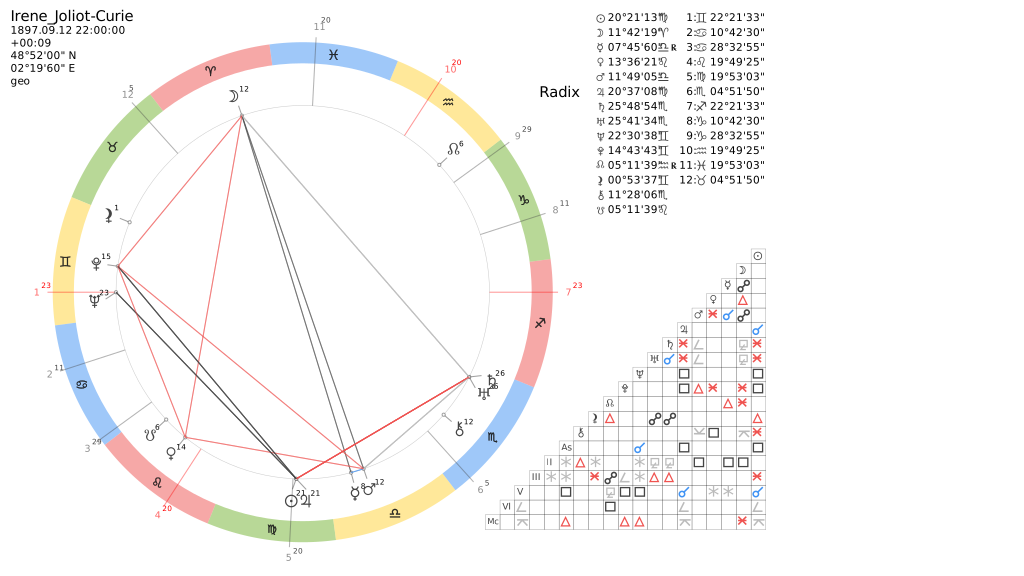
Irène Joliot-Curie (French: [iʁɛn ʒɔljo kyʁi] ; née Curie; 12 September 1897 – 17 March 1956) was a French chemist, physicist and politician, the elder daughter of Pierre Curie and Marie Skłodowska–Curie, and the wife of Frédéric Joliot-Curie. Jointly with her husband, Joliot-Curie was awarded the Nobel Prize in Chemistry in 1935 for their discovery of induced radioactivity, making them the second-ever married couple (after her parents) to win the Nobel Prize, while adding to the Curie family legacy of five Nobel Prizes. This made the Curies the family with the most Nobel laureates to date. In addition to the following honours in the family: the first ever woman Nobel Prize laureate, the first ever person and, to this day, only woman double Nobel Prize laureate, the sole person to this day with two Nobel Prizes in different sciences, thanks to her mother.
Her mother Marie Skłodowska–Curie and herself also form the only mother–daughter pair to have won Nobel Prizes whilst Pierre and Irène Curie form the only father-daughter pair to have won Nobel Prizes by the same occasion, whilst there are 6 father-son pairs who have won Nobel Prizes by comparison.She was also one of the first three women to be a member of a French government, becoming undersecretary for Scientific Research under the Popular Front in 1936. Both children of the Joliot-Curies, Hélène and Pierre, are also prominent scientists.In 1945, she was one of the six commissioners of the new French Alternative Energies and Atomic Energy Commission (CEA) created by de Gaulle and the Provisional Government of the French Republic. She died in Paris on 17 March 1956 from an acute leukemia linked to her exposure to polonium and X-rays.